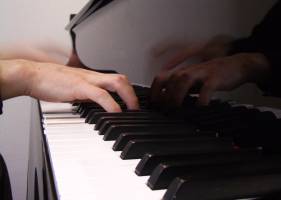
- “one of the most brilliant pianists of the contemporary repertoire” The Sunday Times
Reviews
Both musicians show off their versatility, as soprano Juliet Fraser (external link) gleefully leaps across her impressive tessitura and Mark Knoop rapidly juggles between impossible piano arpeggiandi and wonderfully kitsch synth chords.
read full review
Plans for future operas, like Øyvind Torvund’s other works of the same series, uses the idea of sketching out wild ideas for what a work could be, extending out and over the metaphysical realm of possibilities. Sketches made up of etchings and keywords are projected on to a screen and thought bubbles are materialised through the speakers, which along with the live non-staged soprano and pianist produces a stimulating and often hilarious sensory counterpoint. Over the course of a brisk 45 minutes, Torvund imagines an ASMR overture, a levitation opera for four imaginary sopranos doubling on theremin, an opera for grand piano and ouija feedback amp and many more, culminating with a Gershwinesque ‘misfits’ musical number with an imaginary furry muppet
hide full reviewà la Cookie Monster. Both musicians show off their versatility, as soprano Juliet Fraser (external link) gleefully leaps across her impressive tessitura and Mark Knoop rapidly juggles between impossible piano arpeggiandi and wonderfully kitsch synth chords.

In this release, a bold statement is made right away: a piece for 12 flutes is recorded by a single flautist, and a piece for eight violins is recorded by a single violinist. So on for the whole disc: this is recorded music. Not just out of convenience, but for reasons imminent to the music, such that it’s almost an argumentative point on the part of the label.
read full review
Any discussion of Aldo Clementi’s music must begin, it seems, with the technique of canon. No doubt, it’s a reasonable place to start. Comparisons to the Musical Offering or the Art of Fugue are not uncalled for. But in listening to all that dust’s recent recording of four works from the twentieth-century contrapuntal master, I find my attention drawn to just about everything else.
In this release, a bold statement is made right away: a piece for 12 flutes is recorded by a single flautist, and a piece for eight violins is recorded by a single violinist. So on for the whole disc: this is recorded music. Not just out of convenience, but for reasons imminent to the music, such that it’s almost an argumentative point on the part of the label.
The packaging and liner note both highlight the binaural aspect of the recordings, recommending ‘good quality over-ear headphones’ and for good reason. The real stars of this show are Mark Knoop and Newton Armstrong. The former particularly for his curation as producer: a timbral through-line emerges across the four pieces, arcing from the right of a spectroscope to the left, gently guiding us from airy and high to earthy and low. The latter in his capacity behind the recording console, particularly for the exquisite mixing and mastering. In every sense, this recording sounds good.
Not long into the first piece, I was reminded of my first encounter with fractal-zoom videos as a teenager, where the infinite variety yet unmistakable signature of the Mandelbrot set is explored through a process of finer and finer visual magnification. Like the Mandelbrot set, a canon as written by Clementi is essentially a process of computational iteration. They also share a certain automatic nature; a mechanism is set in motion that produces its own results. They also share, I would argue, a clearly defined membrane between the pure thought, or, in mathematical terms, the function, and the aesthetic presentation of that function. Each iteration of the function that produces the Mandelbrot set is shaded a different colour, producing the recognisable imagery. With Clementi’s work, at least the four pieces presented here, I would argue that the instrumentation, the duration and the spatialisation as rendered by the production are an arbitrary form draped upon contrapuntal-geometric material that is (in theory) eternal. Hence, one musician performing the role of 12 doesn’t flatten but, rather, emphasises the music. It is as if, as in the course of a fractal zoom, one stops and beholds the current spectacle, then some time later marvels at a new spectacle several orders of magnitude smaller, and so on. There is a strong sense of unity across the whole. And so it is difficult to describe one piece without also describing the others. What really differentiates one work from another is the instrumen tation. Perhaps, then, Clementi could be equally lauded for his orchestration as for his canons.
The aptly named Ouverture (1984) opens the disc, a piece for three flute quartets, all per formed by Kathryn Williams. Sinusoidal melodic motion wafts around at various pitch levels. Listening to the work is like walking the halls of a conservatory, the students all practising their scales at different pitch levels and tempi. Given that there are 12 contrapuntal lines, what is remarkable is not the density of the music but, rather, its crystalline clarity, accentuated by Williams’ focused and pure flute tone.
L’orologio di Arvecia (1979) smoothly transitions from glassy flute to metallic ping: two glockenspiels, two celestas, two vibraphones, piano, chimes and gong. Clockwork imagery is obvious to the point that it recedes into the back ground. Coming to the fore is the elegant shape carved over the entire nine-minute span. The piece is divided into two halves, the first for the high instruments, the second for the low instrument, bound together by the gong’s iridescent blooms of sound.
Melanconia (2001) is recorded by eight Mira Benjamins with a drawling husky violin tone. Composed in pairs of violins, one of which is muted, it sounds like a hurdy-gurdy as imagined by M. C. Escher. Three blocks of identical or similar material follow in sequence, reversing the roles of muted and unmuted instruments, and gradually reducing the tempo each time, thus gradually closing the spectral space.
Canone circolare (2006) concludes the album on an ambiguous tone. Or, perhaps, an ambiguity underlying all the preceding works finds its most distilled expression here. ‘The score,’ according to Laura Tunbridge’s liner notes, ‘indicates that one group of four players is echoed by another, but how many times to repeat, how to assign parts to the repeat, or how the repeat might interlock with itself is left unclear.’ As with the previous piece, the tempo gradually sinks, the timbre grad ually dulls, the energy gradually fades.
hide full review

A spellbinding performance, recorded last March at London’s Henry Wood Hall, features pianist Mark Knoop with a quartet of string players from the ensemble Apartment House (external link).
read full review
Piano arpeggios glint like bright light cresting ripples in water. Wispy chords float with disconcerting reticence from a quartet of strings. Perception of silence in regular pauses is illusory, as is the impression of routine repetition and recap. Seemingly discrete events overlap; the piano’s sustain pedal glows in the gaps. This late Feldman (external link) opus is a magisterial accomplishment and a sustained evasion; an invitation to get lost. A collection of Erik Satie’s writings was published as Memoirs Of An Amnesiac. This long, circuitous Feldman composition, so dependent upon his finely cultivated intuition and refined grasp of music’s secret sources and latent dimensions, might have shared that title. A spellbinding performance, recorded last March at London’s Henry Wood Hall, features pianist Mark Knoop with a quartet of string players from the ensemble Apartment House (external link).
hide full review
Exquisitely recorded and played, just the right amount of necessary grain and whisper in the strings (not to mention respiratory quality) and such touch on the piano. Great stuff.
read full review
The question arises every so often: Do we really need any more Morton Feldman (external link) recordings? The obvious answer is, “sputter of COURSE we do!” Piano and String Quartet, originally written for Aki Takahashi and the Kronos Quartet, doesn't seem to get recorded as often as other late works. I have five or six but the recent issue on Another Timbre with Mark Knoop, Mira Benjamin, Gordon MacKay, Bridget Carey and Anton Lukoszevieze is my favorite thus far. Exquisitely recorded and played, just the right amount of necessary grain and whisper in the strings (not to mention respiratory quality) and such touch on the piano. Great stuff.
hide full review
Most sonically spectacular of all is the metallic sound world of L’Orologio di Arcevia, with its jangling array of piano, tubular bells and ’spiels, apparently inspired by the sound of a clock in a belfry. It comes wonderfully alive in the performance by Joe Richards and Mark Knoop, and heard as intended through headphones, it’s fabulously involving, too.
read full review
Two years ago, all that dust released a performance of
Stockhausen ’s Kontakte recorded in binaural format, which made marvellous sense of the spatial effects between the instrumental and electronic sounds. The label has now given binaural treatment to four pieces by Aldo Clementi, who died in 2011 at the age of 85.Clementi was a member of the same generation of avant-garde Italian composers as Bruno Maderna, Luigi Nono and Luciano Berio, though he never adopted the concepts of total serialism as eagerly as his better-known contemporaries. Instead, he sought out other ways of organising his music and creating the intricate polyphonies that he imagined, and found what he needed by going back to the age-old techniques of imitation and canon.
The music he composed using these principles from the 1970s onwards was playful and joyous; it sometimes referenced other composers and styles, and was often exquisitely beautiful. Each of the four pieces here, none of them very substantial, is a gem. Ouverture, for three quartets of piccolo, two flutes and alto flute, was written for the great Italian flautist Roberto Fabbriciani, who recorded it alone by multitracking the 12 contrapuntal lines; Kathryn Williams follows Fabbriciani’s example, placing the listener at the centre of its web of intertwining, echoing voices. The four pairs of violins in Melanconia, all played by Mira Benjamin, move in and out of focus as they chase each other around the aural space, while the four instruments (flute, violin, piano and tuned percussion) in the brief Canone Circolare are given the freedom to choose how and at what distance they repeat the gentle material allotted to them.
Most sonically spectacular of all is the metallic sound world of L’Orologio di Arcevia, with its jangling array of piano, tubular bells and ’spiels, apparently inspired by the sound of a clock in a belfry. It comes wonderfully alive in the performance by Joe Richards and Mark Knoop, and heard as intended through headphones, it’s fabulously involving, too.
hide full review

There’s much to beguile and stimulate in these clever but deep pieces.
read full review
Australian composer Matthew Shlomowitz (external link)’ witty polytonal cycle is performed by compatriot Mark Knoop. The delightful results are shot through with Dada-esque playfulness. As Knoop comments in a podcast, the pieces ‘have that level of silliness where the music is unashamed at doing what it wants to do’. Some pieces are very difficult, he explains: one was ‘unplayable’ so Shlomowitz replaced it.
This is a home-produced album, recorded in Knoop’s own studio. Most delightful are the two opening pieces. Parlour Nancarrow draws on Conlon Nancarrow’s polyrhythmic player piano studies, as well as thematic material from Percy Grainger’s Country Gardens. It has a ‘light music’ plangency that affectingly counterpoints its Nancarrow-derived complexity. A comparable contrast lies behind Ternary (homophony at the minor 6th, Hexatonic cycle at the major 6th), with its senseless ornamentation and bizarre reversals of mood.
As one reviewer comments, the pieces reference kitsch without becoming it. Classic chord progression with Neapolitan, doubled at the minor 2nd is learned and idiotic, Difference, repetition and hemiola explosive and bombastic. There’s much to beguile and stimulate in these clever but deep pieces – I look forward eagerly to Volume 2.
hide full review
It was a beautifully balanced, expertly paced account, one that traced the music’s journey into swelling richness and bleak austerity, with pianist Mark Knoop finding Messiaen-like radiance in Feldman’s extravagant harmonies.
read full review
‘Meaty’ and ‘muscular’ are adjectives not often applied to performances of the sparse, fragile, near-silent music of Morton Feldman (external link). But they feel particularly apt in relation to the day of Feldman’s music, spread across three concerts, given by London-based contemporary music group Apartment House (external link) (below). Indeed, the pandemic-provoked absence of audience and camera close-ups on ensembles and individual musicians felt particularly fitting for this introspective music in which detail is everything. And the Apartment House musicians approached the works with a no-nonsense directness: rather than stressing the music’s meditative stillness and otherworldly spirituality, what emerged was a sonic landscape of jagged, unpredictable irregularities, surveyed sensitively, but also with an honest objectivity that let the music speak for itself.
Apartment House’s middle concert was devoted to the 90-minute Piano and String Quartet of 1985, a late work in which Feldman explores time and scale in music that feels never-changing yet never exactly repeats. It was a beautifully balanced, expertly paced account, one that traced the music’s journey into swelling richness and bleak austerity, with pianist Mark Knoop finding Messiaen-like radiance in Feldman’s extravagant harmonies. The four string players – including Apartment House’s founder Anton Lukoszevieze on cello – played with impeccable ensemble, as if they’d lined up their attacks and chord weighting under a microscope.
In the earlier concert, violinist Gordon Mackay found a child-like simplicity, even folksiness, in the arching figures of For Aaron Copland, while cellist Lukoszevieze returned in the final concert to blur his sonorities with those of horn player Letty Stott in the surprisingly fast-moving Two Instruments. These were concerts of quiet revelations, in terms of both their seldom-heard repertoire and their disarming directness.
hide full review

The concentration is palpable, the effortless synchronisation suggesting telepathy. Pianist Mark Knoop stands out, his every whisper compelling. Don’t think about shelling out for a course on mindfulness — buy this instead.
read full review
Morton Feldman (external link)’s output can serve as a useful post-Christmas palate-cleanser. His is music stripped down to the barest essentials. Piano, Violin, Viola, Cello was Feldman’s final work, an unclassifiable quartet where the participants communicate with the subtlest of gestures. The lack of conventional musical structure is liberating. Don’t sit, pencil in hand, waiting for an emphatic recapitulation or a juicy cadence. Instead, there’s a stately progression of soft string chords overlapping bell-like piano notes. Feldman occasionally hints at conventional diatonic harmony, but these moments don’t jar or stand out unnecessarily. Ideas are half-recalled; tiny motifs are almost repeated.
This intense, emotionally-charged performance lasts for 74 minutes. Near the close, the string voices begin to start their chord notes separately, and a rising piano figure signals the work’s close. That you can’t switch off is largely down to these players. The concentration is palpable, the effortless synchronisation suggesting telepathy. Pianist Mark Knoop stands out, his every whisper compelling. Don’t think about shelling out for a course on mindfulness — buy this instead. Production values are superb, from Sheffield-based Another Timbre. No notes are provided, but Feldman probably would have preferred it that way.
hide full review
There is a palpable sense in which Knoop and company get Piano, Violin, Viola, Cello absolutely right.
read full review
Another Timbre has been contributing excellent recordings to the rapidly expanding universe of what might still be called “Classical” music, and nowhere more convincingly than in the shimmering beautiful tapestries woven by Morton Feldman (external link). The label’s double set of Feldman’s earlier piano works would be an excellent place to begin for anyone wishing to slide into familiarity with his work, as it’s wonderfully performed by John Tilbury and Philip Thomas. Pianist Mark Knoop, violinist Aisha Orazbayeva, violist Bridget Carey and cellist Anton Lukoszevieze now put their collective wit and grace into a rendering of Piano, Violin, Viola, Cello; they give a performance of rapt concentration and emotive depth, rivaling and often surpassing any currently available.
Piano, Violin, Viola, Cello, hereafter PVVC, was the composer’s final published work, but to say that it is typical of his late-period compositions is to sell its individuality short. Much is made of Feldman’s penchant for repetition, and his music is sometimes dismissed for it, but for those immersed in Feldman’s vast canvases, each is a labyrinth of non-linear landmarks slowly revealed, connected non-teleologies that still result in a narrative. Tone, chord and the points at which they meet circumvent while intersecting, the material developing in a kind of slow dance of gradual familiarity and reminiscence. The soft dynamic level makes it all a very intimate experience. True, allegiance to influences as disparate as Debussy and Webern are everywhere, but they are also magically and continuously thwarted, so that they must be sought out to be heard at all. Pointillism is there, something approaching traditional harmonic cadence is also present, but no standard resolution or drama on either front is forthcoming.
There is a palpable sense in which Knoop and company get PVVC absolutely right. The closest version to this one comes from the Bridge label, released in 2015, but the new disc presents a more unified string sound, even though single notes regularly traverse the sound stage. It is as if string clusters produce tones not in the score, such is the intimacy and concentration achieved by these three musicians. Those clusters often take center stage, while Knoop’s piano is recorded wide-screen, in such a way as to embrace the strings. His sensitive rendering of the score is caught in a way that is simultaneously close but recessed, giving the whole a three-dimensional presence that reveals Feldman’s blocks of quasi-development in Technicolor.
Maybe it’s the recording that separates this version from the others I’ve heard. It certainly has the unity of a performance, though its spatial characteristics seem to exist outside of any single performance environment. The room disappears, and the music is left to unfold, offering a very different picture when switching from headphones to speakers. This, in combination with excellent musicianship, makes this version of PVVC a model for Feldman study and for future recorded performances of his works.
hide full review

…they do it marvellous justice: violin lines flit about, birdlike, against a glittering piano backdrop, both instruments sounding as quiet and urgent as a whisper made on an inhalation.
read full review
If you don’t know the deft and gossamer music of Bryn Harrison (external link), this album would be a beautiful place to start. The Bolton-born 40-something fits broadly within a British contemporary music bent for clever, subtle minimalism – his own heroes are Feldman, Messiaen, Skempton. There is, though, something especially economical and fantastical about Harrison’s sound; something in the way he repeats and interlocks fine-grained, shimmering material and keeps us spinning in a magical place between stasis, flux and momentum. He wrote Receiving the Approaching Memory for violinist Aisha Orazbayeva and pianist Mark Knoop in 2011 and they do it marvellous justice: violin lines flit about, birdlike, against a glittering piano backdrop, both instruments sounding as quiet and urgent as a whisper made on an inhalation. Orazbayeva is a taut and boisterous player who doesn’t let a single note rest: this music might be repetitive, but every moment is alert, agile and ready to take flight.
hide full review

… pianists Mark Knoop and Roderick Chadwick, with Newton Armstrong managing the electronics, give us a modern version that is a real contender … the opening woodblock crack, with its accompanying brouhaha of piano turbulence, hits you between the eyes. Right from the get-go, the performance has a confidence that feels right and proper. … The playing cuts through with knockout physicality; the sense that you are been shown multiple sides of an object that is perpetually evolving, spinning in and out of control, is secure.
read full review
I didn’t much care for the version of Stockhausen (external link)’s Mantra that Xenia Pestova, Pascal Meyer and Jan Panis issued via Naxos in 2010. True enough, Mantra is a sound world away from the granular snarl of Stockhausen’s epoch-defined pieces of 1950s modernism; but this Mantra felt too self-consciously pretty in a field dominated still by the Kontarsky brothers’ premiere recording (DG, 7/72 – nla).
Recorded at Kings Place, the concert hall which nestles under The Guardian’s HQ in central London, pianists Mark Knoop and Roderick Chadwick, with Newton Armstrong managing the electronics, give us a modern version that is a real contender. The Naxos version suffered from a narrow bandwidth of dynamics; here the opening woodblock crack, with its accompanying brouhaha of piano turbulence, hits you between the eyes. Right from the get-go, the performance has a confidence that feels right and proper.
Mantra, written in 1970, finds Stockhausen at a point of transition. Behind him lay all those early responses to serialism – Gruppen, Kontakte, Refrain etc; ahead was Licht, his vast and wacky opera cycle, pinned around a network of melodic formulas, an idea about controlling musical material that had its roots in Mantra. As Stockhausen relished explaining, Mantra is underwritten by a 13-note formula that governs every parameter of his composition; but this isn’t Boulez’s Structures. The formula permeates at different speeds and rates; at the most subterranean level, the 13 notes transform electronically, the arrival of each new note heralding a new section.
In the moment of experiencing Mantra, you ought to be aware of this underlying arithmetic as consciously as you tick off the modulations during a Mahler symphony; the sounds are set in motion by Stockhausen’s formula but the music lies elsewhere. And this trio succeed precisely where that overly bureaucratic Naxos version falls down. The playing cuts through with knockout physicality; the sense that you are been shown multiple sides of an object that is perpetually evolving, spinning in and out of control, is secure.
hide full review
Die beiden Pianisten Mark Knoop und Roderick Chadwick bringen das Werk auf der vorliegenden Aufnahme mustergültig zu Gehör. Die Aufnahmen entstanden im Januar 2013 in der Hall Two des Londoner Kings Place; den Instrumentalisten stand der Tontechniker Newton Armstrong zur Seite, der auch für die Bedienung sämtlichen elektronischen Equipments verantwortlich zeichnet.
read full review
Mantra beschließt für Stockhausen (external link) eine fast zwanzigjährige, hochproduktive Phase des Suchens nach einer ureigenen kompositorischen Sprache. In de 1950er und 1960er Jahren entstanden unterschiedlichste Werke und Werktypen, von Raummusik (Gruppen, 1955–57) über Obertonmusik (Stimmung, 1968) und immer wieder Elektronik (etwa Studie I und II von 1953/54) bis hin zur Schaffung eines eigenen Improvisationstypus mit den Grundsätzen der «Intuitiven Music». Die serielle Technik war dabei stets — wenn auch nicht vordergründig — präsent und spielte bei der Konstitution von Stockhausens Werken eine grundlegende Rolle. Mit Mantra präsentierte er in Donaueschingen 1970 zum ersten Mal seine Weiterentwicklung des deterministischen Ansatzes in der «Formelkomposition», die gleichzeitig eine radikale Rückkehr zu diesem Prinzip und seine Transzendenz darstellt.
Eine Formel ist demnach der thematische Nukleus, aus dem sich alles musikalische Geschehen innerhalb des jeweiligen Werks ableitet. Wie bei der Serie auch ist jedes Ereignis innerhalb der Formel mit Tonhöhe, Rhythmus und Dynamik festgelegt, verfügt darüber hinaus aber noch über defferenzierte Artikulationsangaben. Vorgaben zur Akzentuierung sowie gegebenenfalls periodische ober aperiodische Repetitionen, Triller und Tremoli. Motivische Arbeit findet nicht statt, stattdessen wird die Formel in verschiedenen Abwandlungen — Spiegelung, Umkehrung, Augmentation, Diminution, Ausschnitte etc. — zum Material der Komposition. Die größte Augmentation der Formel bildet die Gesamtstruktur des Werks ab, was in Mantra in einer Gliederung in 13 Sektionen resultiert, die den 13 Tönen der Formel entsprechen. Damit geht die Formel im Mantra auf und umgekehrt — radikalere Konsistenz ist kaum denkbar.
Bemerkenswert ist dabei die schiere Diversität an Klängen, die Stockhausen durch dieses vermeintlich trocken-theoretische Dispositiv von den beiden Pianisten erzeugen lässt. Beide bedienen neben ihren Instrumenten einen chromatischen Satz Zimbeln sowie einen Holzblock, zusätzlich werden sämtliche an den Flügeln erzeugten Klänge durch einen Ringmodulator bearbeitet, der ebenfalls mit der Grundlage der Formel operiert. Das von diesem relativ minimalen Setup freigelegte Klangspektrum reicht von diversen Formen harmonischer Verstärkung über galaktisch anmutende Effekte tief-frequenter Amplitudenmodulation, einer weiten Spanne von becken- und gongähnlichen Klängen, mikrotonalen Verstimmungen und Glissandi hin zu spektralen Farben. Die «Effekte» werden dabei zu integralen Charakteren des Werks und erscheinen mitunter als Varianten der 13 Artikulationstypen.
Die beiden Pianisten Mark Knoop und Roderick Chadwick bringen das Werk auf der vorliegenden Aufnahme mustergültig zu Gehör. Die Aufnahmen entstanden im Januar 2013 in der Hall Two des Londoner Kings Place; den Instrumentalisten stand der Tontechniker Newton Armstrong zur Seite, der auch für die Bedienung sämtlichen elektronischen Equipments verantwortlich zeichnet.
hide full review
The highlight of the concert was Faust, or the Decline of Western Music for solo pianist, video, and “various materials” by Trond Reinholdtsen (external link).
read full review
„Der Varèse ist ein richtiger Ohrwurm“, sagt eine Konzertbesucherin zu einer Bekannten in der Pause. „Der Varése“, das ist ein rund achtminütiges Stück elektronischer Musik – und nicht unbedingt das, was die meisten Leute so vor sich hinsummen.
Aber das Poème électronique, komponiert für den Philips-Pavillon auf der Weltausstellung in Brüssel 1958, am Samstag in Bremen im ersten Teil des zweiten Konzerts des Festivals der „projektgruppe neue musik“ im Konzertsaal der Hochschule für Künste von Band zu hören, klingt tatsächlich nicht nur ungemein frisch, sondern auch griffig, mitreißend in seiner Kombination von gesampelten Geräuschen und elektronischen Glissandi. Dazu sind Bilder zu sehen, archaische Artefakte, Masken aus der Frühgeschichte der Menschheit, Skelette, später Massengräber und der Explosionspilz der Atombombe. Die elektronische Musik steckte noch in den Kinderschuhen, der Weltkrieg steckte dem Kulturbetrieb noch in den Knochen, die Aufgabe der Künste war als emanzipatorisches Projekt klar definiert.
Dass sich Komponisten der Neuen Musik heute aus einem kaum überschaubaren Fundus bedienen können, im Zuge dessen verstärkt mit Versatzstücken des Vorhandenen arbeiten, sie bearbeiten und neu kombinieren, steht im Fokus des diesjährigen Festivals der „projektgruppe neue musik“, das unter dem Titel „escape ungefähr gleich enter“ steht. In den meisten der Konzerte wurden Klassiker der Neuen Musik mit neuen Werken konfrontiert.
Nach Varèses Poème électronique, dem wiederum Yannis Xenakis’ Concret PH vorausging, das ebenfalls für den Brüsseler Pavillon komponiert worden war, dirigierte Jagoda Szmytka (external link) das Ensemble „MAM. Manufaktur für aktuelle Musik“ durch ihre Komposition inane prattle, was in etwa so viel heißt wie „dummes Geschwätz“. Das Stück für Trompete und verstärktes Ensemble gibt sich dabei gar nicht geschwätzig, sondern scheint im Gegenteil streng organisiert, über einen schweren Puls, wobei die Klangsprache gelegentlich an Spielweisen des Freien Jazz erinnert. Dazu gesellt sich für eine Weile eine Stimme, leicht verzerrt, wie aus einem Telefonhörer oder einem alten Radio kommend. So leise allerdings, dass, und wäre es dummes Geschwätz, die Musik sich davon nicht beirren ließe.
Der Höhepunkt des Konzerts war dann Faust, or the Decline of Western Music für einen Solo-Pianisten, Video und „diverse Materialien“ von Trond Reinholdtsen (external link), das in der Galerie der Hochschule aufgeführt wurde. Das Werk eröffnet mit der Aufzeichnung einer Lecture Performance, in der es zunächst ganz seriös zuzugehen schien, die aber in ihrem Verlauf immer bizarrere Formen annimmt und schließlich in einem Wortsalat kulminiert, bis Klaviermusik einsetzt. Allerdings nicht von dem am Flügel sitzenden Mark Knoop gespielt, sondern aus der Konserve. Worauf Knoop den Deckel des Flügels herunterklappt – ohne einen Ton gespielt zu haben – und unter das Instrument kriecht, wo er an Schrauben und Pedalen hantiert.
Später wird er im Dialog mit vorproduzierten Sequenzen krachende Cluster und dramatisch flirrende Tonkaskaden spielen, während an der Bühnenrückwand zu sehen ist, was Regieanweisungen zu sein scheinen, unergründliche Buchstabenfolgen, eine Auflistung des Faust-Personals, erläuternde Anmerkungen zu verschiedenen Ebenen einer abstrakten Handlung, die im Kontext des Werktitels gelesen als Erörterung des Stands der zeitgenössischen Musik in sieben Teilen zu lesen ist.
Dabei kommen im Verlauf des Stücks unter anderem ferngesteuerte Autos, ein Porträt von Karl Marx, Würstchen vom Grill sowie Kunstnebel und Seifenblasen vor. Ein höchst kurzweiliger Beitrag zur Debatte über das Wohin in der Neuen Musik.
hide full review
The Vuille/Knoop partnership shines …
read full review
James Saunders’ You Say What To Do (2014) explores a similar conceit, in more exuberant and ramshackle form. Two musicians are armed with an array of musical (and not-so-musical) sound sources: alarm clock, party horns, Stylophone, whoopee cushion, mini Korg monosynths, toy percussion instruments, etc. These are bashed and blown and triggered according to a matrix of simple instructions called out by a team of “assistants” drawn from the audience immediately before the performance. Like a musical Stanford Prison Experiment, some of the assistants perform their role with considerably more dictatorial gusto than others, leading to an absurd and hilarious performance as the musicians race to fulfil the demands. “Everyone’s set up to fail,” Saunders explains afterwards, “the aim is for everyone to do the best they can.” Performers Serge Vuille and Mark Knoop certainly strive for that, approaching the task with wild commitment.
The Vuille/Knoop partnership also shines in Jessie Marino (external link)’s weird, fun, occasionally creepy, Heartful Bird, Vivid And Great In Style (2014), in which they re-enact physical actions taken from no-budget American public access television and David Bird (external link)’s Fields (2010), performed on top of the swooping metal roof of Aarhus’ Godsbanen arts centre (the repurposed freight train depot). The relentless sound of their snare drumming begins to ricochet off the surrounding buildings, as if the whole city has become a huge vibrating surface. It’s a beautiful experience, thrilling and dramatic.
hide full review
But perhaps the true star of the evening was pianist Mark Knoop who had been present in one performance or other throughout the week. Tonight he took centre stage and the brilliance of his interpretations gleamed in the limelight.
read full review
It is tempting to attribute Michelangelo Pistoletto’s Ten Less One, the performance which brought this week long festival to a close, to an act of insurgency. As the Italian artist’s collaborator Lorenzo Fiaschi brought his sledgehammer to bear on nine of the ten elaborately gilt-edged mirrors that had framed and multiplied the performance space throughout the week, we might speak of the destruction of bourgeois values or the death of postmodern reflexivity. But we could just as well see the piece as symbolic for the shift effected from Scarlatti to Sciarrino (external link), highlighted in the programme which precedes it.
Placing the intimate, impressionistic keyboard sonatas of the Neapolitan classicist alongside recent works for piano and string quartet by his modern successor, Sciarrino lays bare their hidden continuities. Like Pistoletto, Sciarrino breaks apart Scarlatti’s smooth surfaces into isolated fragments of glistening light and colour, hurtling through space. On Escerzi Di Tre Stili, Sciarrino’s transcription for strings of Scarlatti’s keyboard pieces, melody lines become passages between sharp intensities, bursting with life. But perhaps the true star of the evening was pianist Mark Knoop who had been present in one performance or other throughout the week. Tonight he took centre stage and the brilliance of his interpretations gleamed in the limelight.
The evening had an unexpected coda, however, after Lorenzo Fiaschi took his bow from violently exposing the coloured surfaces lying behind the glass of nine mirrors. “Ten,” he announced with a prim smirk, “less one.” But that wasn’t enough for one audience member. Russell Haswell rose unannounced from his seat at the edge of the stage and brought the mallet down upon the final pane. Here finally was our act of insurgency, from the man who a week earlier had proposed to smash the place up.
And nothing could have been a more fitting end to a festival that has been like a week-long insurgency against an often staid and complacent contemporary music establishment. New histories have been written here and enacted live, and new futures have been promised and envisioned. Nowhere else could one find the inspiring performance poetry of John Giorno programmed beside the experimental operatics of George Aperghis, the atmospheric glitch jazz of Supersilent beside the febrile paleo-black midi of Conlon Nancarrow, the neon vaporwave of Fatima Al Qadiri besides Leon Michener’s lysergic vamps on Wagner’s Ring, and for it all to fit together, knotted tight by a series of provocative conceptual gambits that make the LCMF the diametrical opposite of the supermarket-like laissez-faire of so many modern festivals. Frankly, the whole festival has been little short of miraculous and I, for one, cannot wait for next year’s.
hide full review
… pianist Mark Knoop played his imposing, increasingly confrontational Fifth Piano Sonata, interspersing the Sciarrino with slightly indulgent performances of Scarlatti keyboard sonatas.
read full review
Launched last year, the London Contemporary Music festival is the latest addition to the capital’s new-music scene. There’s a rough-edged sense of eclecticism about it, and a first impression suggests it might well become the 21st-century replacement for the much missed Almeida festival, which introduced so many composers to this country during the 1980s.
What LCMF lacks so far is a permanent venue, and this year’s six days of concerts took place in Second Home, just off the East End’s Brick Lane, which is due to become a creative business centre later this year. The performing space was bounded by the mirrors of Michelangelo Pistoletto’s Ten Less One, whose destruction was designed as the smashing climax of the week.
Programmes have ranged across the musical spectrum, from critiques of capitalism and British 1970s experimentalism to Noh theatre and electroacoustic sets, while the final event included two UK premieres from one of Europe’s leading living composers, Salvatore Sciarrino (external link). The Quartetto Prometeo, regular Sciarrino collaborators, brought his Seventh and Ninth Quartets to the UK for the first time, and pianist Mark Knoop played his imposing, increasingly confrontational Fifth Piano Sonata, interspersing the Sciarrino with slightly indulgent performances of Scarlatti keyboard sonatas.
It was a cleverly conceived programme, and despite all the reflective surfaces and swaths of unadorned concrete, the acoustics seemed remarkably good; the Prometeo made sure the crying, whispering soundscapes of Sciarrino’s quartets were never lost. The two quartets were sharply contrasted: the Seventh, from 1999, a compact single span, and the Ninth, completed two years ago, cast a more expansive pair of movements, which begins with frozen, glassy chords before moving into a more animated world of swoops and sighs. The connection with Sciarrino’s stage works is hard to miss: this is abstract drama, as potent in its own way as any of his music-theatre pieces.
hide full review
[Nono’s] luminous late work …sofferte once serene… for piano and electronics showed his faith was not misplaced. It was beautifully played here by Mark Knoop.
read full review
Anyone who loves modernist art must feel a twinge of nostalgia for those heroic times when artists wanted to change the world, audiences rioted in response, and the gendarmerie had to be called to restore order.
A touch of that old fighting spirit returned at the London Contemporary Music Festival, a week-long celebration of cutting-edge music which ends on Sunday June 1. On the first night the police were called, when residents near the venue in Whitechapel complained about the volume of the final performance, from the British “industrial noise” group Consumer Electronics. I missed this historic event, alas, but I did see something much more subversive the following night.
This was the quietly articulate German composer Johannes Kreidler (external link), explaining the mechanics of his piece Fremdarbeit (Outsourcing). He told us without a trace of embarrassment that he merely sketched his piece before “outsourcing” the filling-in of the detail, firstly to a Chinese composer and then (to create several new versions), to an Indian computer programmer. His air of studied neutrality trembled only slightly when he told us his fee was 1500 dollars, and theirs was around 5 per cent of that.
This was the moment for us all to cry “shame” and throw vegetables in his direction. But this is 2014, when no one can be outraged by anything, so we all sat dumbly while the music was played by a group of half a dozen musicians, one of them firing off tiny samples of treacly American soul music. The combination of these with the mechanical, vaguely modernist sounds of the instrumentalists was deeply disconcerting. It seemed to show modernism can be faked and mass-produced as easily as a hit single.
The following piece proved precisely the opposite. The Italian composer Luigi Nono was as fiercely anti-capitalist as they come, but unlike Kreidler he clung to a romantic faith in the sovereign power of the solitary creative artist. His luminous late work …sofferte once serene… for piano and electronics showed his faith was not misplaced. It was beautifully played here by Mark Knoop.
These two pieces both featured in the event dubbed “Marxist Chillwave”, which also included Cornelius Cardew’s tenderly beautiful set of piano variations on “We’ll Keep the Red Flag Flying”, and a stark film with music that laid bare the sweatshop conditions of the global fashion industry. The other evenings were also built around themes of different kinds. One of them focused on the strange transformations of Japanese musical culture, juxtaposing the ritualistic formalism and understatement of Noh theatre with the frenzy of contemporary Japanese noise music.
In all, the week has been enthralling. It’s been a long time since London has been offered a survey of new music so wide in taste, clever in programming and engaging and stylish in presentation. Long may it continue.
hide full review
After a brief introduction from the curators, cellist Anton Lukoszevieze, and pianist Mark Knoop take to the stage. What follows is truly inspiring.
read full review
Those not residing in Cambridge seem to live under the dissolution, just as I did some 5 years ago, that the city is some sort of cultural hubbub; glistening with emerging and forward-thinking artists, alive with tantalising creatives, and home to plenty of venues and events in which to showcase this artistry.
However, this is not completely the case. As a prospective student I was excited to be studying Classical music in such a city, assuring myself that outside of the capital it truly was the best place to be to soak up the rich musical tapestry I was there to study.
Yet, since living in and indulging in Cambridge I’ve noticed that the Classical concerts on offer seem very much rooted in just that, the ‘classics’. Excepting one Charles Ives concert last year, the sprinkling of concerts during ‘The Festival of Ideas’, and the concerts I myself take part in as part of the Anglia Ruskin Orchestra and Chorus, there seems to be nothing displaying some of the more adventurous works of the 20th and 21st Century.
Imagine my delight when Kettle’s Yard announced their latest series of ‘The Sunday Concerts’, dedicated to showcasing “New Music in Cambridge”. Fittingly on what must be the first sunny Cambridge day since September I eagerly arrived at Kettle’s Yard where I was greeted by the prim and proper offer of, not tea, but a cup of coffee, which I take black, of course.
The venue itself, a small gallery I hear referred to as ‘The Office’, is completely fully booked. This, the second in the current series of concerts is dedicated to the memory, life, and work of Michael Harrison, the late Director at Kettle’s Yard the compositions were created by New Music Associates that he appointed while at Kettle’s Yard. Complete with a white sheet covered sofa (one can only presume is reserved for the elite, or rather, latecomers), the room is engulfed with partially tiered seating, literally occupying every possible crevice of the space, leaving no corner or alcove chair-free.
I sit, front row, with the keyboard clearly in view, about to be brought to life by the pianist’s hand. The eyes of other patrons seemingly filled with envy as I am fortunate enough to have secured what I, and evidently they, believe to be the best seat in the house, or “office” . . . Their eyes, apparently questioning the drainpipe and denim jacket clad matchstick of a man currently disturbing the wash of beige and tweed.
Temporarily distracting my attentions to these glances is my observing of the piano’s placement in the room. It appears to be some two inches skewed from being straight; leaving me pondering the subliminal possibilities of a clever clerk, or simply the carelessness of the gallery’s staff. However, I must remind you, and myself, today’s concert is completely full. Before the music even begins this is already an achievement, a great success amongst Cambridge dwindling but thankfully still burning cultural wick.
After a brief introduction from the curators, cellist Anton Lukoszevieze, and pianist Mark Knoop take to the stage. What follows is truly inspiring.
Beginning with four Refrains, scored for both instruments, a mood is immediately set. The first two, composed by Mark Bowden and Anna Meredith respectively, have a similar style; both displaying the slow, simple, and light character of a more-tonal Messiaen, played at half tempo. The cello swoons over low piano drones, penetrated with the occasional dainty chord in the upper reaches of the keyboard’s range. Despite the very occasional slip in intonation it is a confident and considered open to the concert, conjuring images of a epically romantic and overblown end to a film.
The third Refrain, by Charlie Piper, demonstrates daring and technically demanding textures, glittering and dancing around the space. While, Christopher Mayo’s Refrain 4’s extended use of harmonics could have been an equally wonderful work, though the occasional slip in intonation did make this audience member slightly uncomfortable through its performance.
It is at this point the concert takes a sudden shift. The opening four pieces have settled the audience, leaving us deep in thought and very calm, however as Knoop leaves the stage, Lukoszevieze readies himself for the following two pieces for cello solo, IMMH by Kenneth Hesketh, and John Woolrich’s In Unknown Country, and the energy in the room alters.
Lukoszevieze suddenly attacks the first notes of IMMH. This piece, the concert’s highlight for this reviewer, is effectively a box of tricks, demonstrating the true capabilities of the instrument. Hesketh evidently knows the instrument well, making use of harmonics, striking of the body and strings, truly pushing the boundaries of the dynamic range of the instrument; there are very few things as truly invigorating as seeing a cellist truly wield their skill. The quasi-Russian undertones and virtuosity of IMMH are greatly contrasted with In Unknown Country, whose slower and more calm character allows the mood to relax, still on a comedown from the excitement of the previous piece. In Unknown Country’s Romantic contours pass all too quickly for this reviewer, such was the intensity of its predecessor I am unable to truly immerse myself in its soundworld.
Knoop returns to the stage, and Lukoszevieze makes way, residing perched on the edge of the stage, for it is his piece for solo piano, What we really want to do is serve happiness which follows. Based on the rhythmic content from sentence to which it owes its name the piece is a gentle chord cycle, slowly developing from partially dissonant clusters to more rich and triadic chordal motifs. Making use of the piano’s lower register the piece vaguely trots along, never really leaving its comfort zone or pushing the ear in any particular direction. This is not to dismiss the piece however, the chord construction and rhythmic cells are intriguing enough, and any form of diversion from the established mood would serve only to distract from the processes being displayed.
Again, the performers exchanges positions. Richard Baker’s Crossing Stones (after Richard Long) for cello solo is an aural and tactile assault. Its unrelenting volume and presence causes the ground to vibrate, causing the audience to feel every bow, every glissandi, impossible to even hear one’s own thoughts such is the power of this composition. Major scales leads us into familiar and comforting territory before submerging us back to the depths of a-tonality, with the melody, always accompanied with a lower open string drone, pushing the upper limits of the cello’s register. When the piece climaxes and suddenly finishes there is a deathly pause among the audience, which while only lasts a fraction of a moment, feels like an eternity.
The final piece, In memoriam Michael Harrison is scored for cello, piano, and audience. We are invited to hum along a drone, given a choice of two notes. Tentatively the audience oblige and once the texture is realised the two begin. Knoop has prepared his piano, seemingly placing unknown materials between the strings and spends the entire piece bent over inside the piano, plucking the strings and caressing its echoing contours. The cello sings above both the piano and the audience, and when the piece dissolves to a gentle end the audience collectively fade out.
After a lengthy round of applause a handful of today’s composers enter the stage from the audience to take a bow. After a brief thank you the audience return to their previous state, I feel their stares and sense the awkwardness as they make a slow but determined gate for the exit.
I leave daintily, carefully considering my every stride and glance. However, I am satisfied, elated, truly excited for the rest of the series, and above all, encouraged.
hide full review
Mark Knoop at the piano was a captivating presence, a storm of rapid movement and intensity. [...] Knoop played masterfully, passionately when required, but with lightness and delicacy at other moments.
read full review
The second weekend of the London Contemporary Music Festival 2013 kicked off with ‘New Complexity and Noise’, an event exhibiting two strains of avant-garde music practice that emerged in the 1970s, a move towards “the outer limits of density and possibility” contrasted with free-improvisation’s move into spontaneous action. The complexity part of the evening encompassed the furious proliferation of Michael Finnissy (external link), an avalanche of bass notes rumbling like thunder, interrupted by sudden gusts of silence; the violent parps, spluttered outbursts, and contorted bass twists of Aaron Cassidy; a trombone piece by this composer taking in delicate muted whistles and almost feedback-like tones. A highlight was the second Finnissy piece which was almost gothic in its buttressed grandiosity; each flurry of piano notes only serving to further knot and tangle the music in an ever-plunging elaboration. Mark Knoop at the piano was a captivating presence, a storm of rapid movement and intensity. This, for me, was an introduction to some very unfamiliar music; it was effective in making me want to seek out more.
The improvisation and noise part of the evening found my ears in more familiar but no less fascinating territory. Steve Noble and Anthony Pateras whipped up virulent electronic froth, Noble provided a machine-gun counterpoint, strafing the sound-field with rapid clattering, using small bowls, cymbals, bowed drones, and metallic screams. It closely meshed with Panteras’ synth in a wild dance. Noble took a solo turn with a clash of cymbals and violent rings echoing off the walls; industrial screams soaking the bare concrete. Noble is a master of controlled frenzy and constrained chaos. A Pateras solo was centred around blurts of pixelated bass blast, like hundreds of tubas blowing in unison; the passing trains, for once, barely intruding on the sound at all.
Russell Haswell closed ‘New Complexity and Noise’ with a set that seemed to be mimic earlier ones and compress their sound into spraying molten audio-shards. I thought I could detect piano chords and Noble’s drums beneath the harsh maelstrom; although, this may have just been an aural hallucination caused by Haswell’s pulsing, jagged noise wall. He occasionally leaned towards something more dancefloor friendly before another deluge of fractured analogue slurry erupted from the speakers. An impressive, atavistic set, full of texture; it never became merely an exercise in extremity, but extreme it was; a deafening, assaulting, nulling war on ears and minds. Bold Tendencies was buried in the sound of roaring circuits and raging magma filled wires. A white-noise expressway to yr skull; a destructive and blissfully transcending ascension.
The final session of the festival was ‘Keyboard Breakdown’, a tour of harpsichord and piano music, from French Baroque to American Minimalism and beyond. Jane Chapman seated at the harpsichord tore through the repertoire, playing beautifully, the material diverse and broad, the 18th century music clashing engagingly with the avant-garde activity of Paul Whitty. She closed with György Ligeti’s rapidly mutating Continuum.
A performance of Terry Riley’s Persian Surgery Dervishes sucked the audience into a pulsing repetitive vortex of hypnotic drone, a psychedelic blur of tumbling notes and humming pipe-like tones, under shimmering harmonics. It built to a euphoric plateaux.
Closing the festival was Mark Knoop’s full-spectrum piano tour. Beginning with Frank Liszt’s Unstern! and terminating with Philip Corner’s performance piece Piano Activities, the set took in Schoenberg, Mozart, Xenakis and Morton Feldman (external link). Knoop played masterfully, passionately when required, but with lightness and delicacy at other moments. The sequence was a continuous and gripping procession of music, each piece complementing and contrasting effectively with the next. As the final note of Schoenberg’s Drei Klavierstücke rang out, Knoop began to hammer the piano lid back into the body of the instrument. Joined by other performers, he, and they, demolished the piano using chains, hammers, and their own hands. Keys were smashed; strings plucked and rubbed; the whole body of the instrument singing in a violent symphony. The performance was at once disturbing, the destruction lit by only a single hanging bulb, and exhilarating, the thrill of witnessing something so creatively destructive; Piano Activities was the perfect way to close the LCMF, a performance of real power, the audience shocked out of apathy, a palpable tension in the room.
This inaugural London Contemporary Music Festival was a great success and a considerable achievement. The policy of free ticketing ensured a broad and curious audience, the venue was innovative, the programme fascinating, and the performances memorable. I look forward to the 2014 edition with great excitement.
hide full review

… in terms of performance, Mark Knoop’s rendition of the piano works stands out more: even when he is essentially just channeling Argerich, he still finds room – somehow – for a fresh interpretative stance of his own, and this is a pianistic achievement of the highest order.
read full review
Microtimings contains three multi-part works, scattered across the two CDs. Disc 1 is performed by pianist Mark Knoop, and Disc 2 by the Kreutzer Quartet (external link). The Études d’un prélude are “based on a precise transcription of Martha Argerich’s 1975 recording of Chopin’s Prélude in E minor, Op. 28, no. 4.” The Artist and his Model does something similar with Alfred Corot’s 1931 recording of Debussy’s “La fille aux cheveux de lin”, and nach Webern, nach Pollini uses Maurizio Pollini’s 1976 recording of the second movement of Webern’s Variations for Piano, Op. 27.
Approaches to the material vary. Étude d’un prélude I—Chopin desséché is a direct (piano) transcription of Argerich’s recording, simply slowed down and re-notated such that her minute rhythmic nuances and touches of rubato can be written in quavers and semiquavers. The “dessication” of which the title speaks results from only the initial attack of each note being sounded. The Artist and his Model II—La durée sans contacts s’affaiblit, for string quartet, does something similar: it slows the recording to a tenth of the original tempo but retains its detail precisely, even including the white noise.
Others are more convoluted in how they are manipulated, and the Webern/Pollini piece (all for piano) perhaps unsurprisingly draws a more abstracted approach. Movement I—Neuordnung nach Dauern retains Webern’s original rhythmic and dynamic cast for the movement, but “reorganizes all of Webern’s pitches according to their duration in Pollini’s recorded performance;” Movement III—Neuordnung nach Lautstärken does the same but with the notes’ volume rather than duration. Two of the Chopin/Argerich Études – 28four (for string quartet) and four28 (for piano) – do the same thing, or something similar, organizing material according to the duration of the recorded sounds.
A third category within these pieces includes those which have been composed rather more freely; that is, with fewer rules governing the precise placement of the notes. Oddly, though, these works are if anything more arcane than the others in terms of their structure and genesis, mostly being composed “after,” or “directly in response to,” or “as an analogue to” various paintings or photographs. I can do no better with Étude d’un prélude VIII—Kertész Distortion (for string quartet), for instance, than to quote the liner notes: the piece “was composed as an analogue to André Kertész’s photograph, ‘Distortion No. 172,’ made in Paris in 1933. The photograph is of a nude as seen in a curved mirror. The composition treats the Chopin-Argerich material in an analogous fashion, curving the time (and the pitch) just as Kertész’s mirror curved the light.” It’s a ludicrously specific and obscure brief, but the result is fascinating, and – when you’re listening for it, at any rate – you can really hear the Chopin prelude drift in and out of focus. It is, though, pretty much entirely dependent on an awareness of its concept, and attempting to listen to the work without thinking about how it is distorting its original is a very tough ask. It’s hence not just an aesthetically demanding listen: it’s also an intellectually demanding one, as it really necessitates at least an awareness of what the photograph in question is – as well, needless to say, as a more or less bar-by-bar knowledge of the Chopin prelude.
In other places, such vast amounts of necessary prior knowledge get in the way of appreciation. In the case of The Artist and his Model I—La fille floutée (for piano), the liner notes tell us only that “The piece owes a debt to Gerhard Richter’s 1994 painting ‘Lesende’.” Without being told more precisely how this debt is owed, the listening experience is an uncomfortable one; the piece is too close to the Debussy/Cortot original to be appreciable as a standalone work, but too far from it to be a straight reinterpretation. And beyond the girl’s hair arguably being flaxen, the connection to Richter’s painting is simply not apparent. This problem is emblematic of what really gets in the way of the project overall: its processes are paraded so clearly as to provoke an unbecoming dependency on them. It isn’t altogether clear what anybody is meant to do with these pieces, beyond compare them to their various esoteric sources.
On these terms, though, it’s frequently a fascinating experience. I think the second CD, which is the Kreutzer Quartet’s, is the better one musically; the extra remove created by the switch of instrumentation gives Beaudoin (external link)’s pieces more room to breathe, and the effects and distortions he draws from the instruments create a thrillingly fleshed-out portrait of the various musicians and artists involved. But in terms of performance, Mark Knoop’s rendition of the piano works stands out more: even when he is essentially just channeling Argerich, he still finds room – somehow – for a fresh interpretative stance of his own, and this is a pianistic achievement of the highest order.
Sometimes the way the CD set presents the music is less than beneficial, and though it’s aesthetically beautiful and informative at times, there is a gap between the level of information which the music seems to demand and that which it actually gives. It’s also ludicrously finicky (“The first three movements of the [Second String Quartet, made up of four Chopin/Argerich pieces] may be performed separately, as individual works. However, 28four may only be performed as the finale of the complete quartet”). I also wonder whether buyers of this CD will be more likely to get that the title four28 “refers to the late pieces by John Cage,” as the notes inform us, or to be able to read four different languages, including ancient Greek, which are included in the booklet without translation.
But while this album is (for me anyway) something of a minefield of conceptual questions, it’s also vital listening for anyone at all interested in performance analysis, recomposition, or any of the three recordings on which the pieces are based. It’s also a masterclass, from the Kreuzer Quartet and especially Knoop, in how to perform rigorous music expressively. It left me a touch more respectful than convinced, but this is hardly an album for the mass markets, and on its own terms it’s an undoubted success. This is music you have to know about to understand, but if you can live with that, it’s worth it.
hide full review
Xenakis sets the piano (the excellent, musical Mark Knoop) in opposition to the strings effectively.
read full review
The idea of this programme, entitled Xenakis Inspires, was to present the music of composers directly influenced by Xenakis’ music alongside music by Xenakis himself. Anaktoria (1989) means “beautiful like a palace” and is the name of a notable woman from Lesbos, with whom Sappho was in love”. Composed at a time of revolutionary uprisings (it was played in factories soon after its Avignon premiere), it is a timbrally interesting piece. Again, there is a prominent bassoon part (linking to Phlegra of the first concert). Silence played a vital role here, as did the obligatory registral extremes.
Roger Redgate’s ST/X-t has a title that at once links to the source of its inspiration. The scoring for string quartet and turntable was novel (was the turntable part improvised? – the player had no score that I could see). The turntable’s sonic swoops were interesting, but sandwiched between two Xenakis scores is nowhere for this “short homage” to be. Xenakis’ Akea (1986) was interesting in introducing some constructs that could almost be described as tonal. The language was gestural, certainly, but the overall impression was of a paring down of vocabulary; less is more. Xenakis sets the piano (the excellent, musical Mark Knoop) in opposition to the strings effectively. A mere eleven minutes in length, the piece made its point tellingly.
Michael Finnissy (external link)’s Talawa received its World Premiere. The title derives from American Hopi Indian mythology and refers to the third phase of the dawn of Creation, “in whose red fully-formed human beings stand to proudly face their creator”. Although there are no direct references to the Hopi Indians, there is a static quality that conjures up timelessness – as does the extended viola solo that is shot through with melancholy (excellently played by Bridget Carey). Thessaloniki-born composer Haris Kittos (external link) gave us Omadón (“Teamed-up”), the form of which was intended to reflect the space of Xenakis’ Philips Pavilion. Kittos asks his oboist to play without the reed, resulting in a strange breathy effect (notes are fingered, which adds more sound). The surface of the music is a hive of activity, and Kittos presents a battle between oboe and strings, the oboe straining to maintain its individuality.
Finally, Xenakis’ Palimpsest (1979) recycles materials form previous pieces (Erikhthon, Khoal and Akanthos) while using characteristic techniques (sieves, Brownian motion, “halo” sonorities). The performance here was intense, the players enjoying the rhythmic play as much as the tension.
One couldn’t help but feel short-changed by the “programmes” for both these Xenakis concerts, though: a token sheet (singular) of A4 paper with brief notes for the pieces and biographies. The fact that the works for this second concert were discussed in an order that did not correspond to the actual performance order didn’t help, either.
hide full review
… it was in the remarkable Akea for piano quintet that the performers really excelled and the concert kicked into a higher gear. Pianist Mark Knoop took the honours here with his growingly robust contribution, but the string quartet deserve equal praise for their own poised realisation of what is a deceptively intense and tricksy piece of music.
read full review
As part of this year’s ongoing Ether Festival the Southbank Centre and the Centre for Contemporary Music Cultures of Goldsmith’s College presented the Xenakis International Symposium, a weekend-long series of events that included a substantial programme of scholarly research presentations, the screening of a film on the composer, a UPIC workshop, and two concerts, of which this performance by Ensemble Exposé (external link) under the direction of Roger Redgate was the second.
Taking up both the archival and the exploratory inclinations of the Symposium, the concert saw the presentation of three important chamber works from across Xenakis’ career, with these being interleaved by three world premiere performance of works by composers for whom Xenakis has been a significant figure. In doing this the concert provided a fascinating illustration of the shifting compositional concerns of the composer whilst at the same time showing these in something of a fresh light through the relief of the new works.
Beginning with the chronologically earliest work on the programme, Anaktoria for octet from 1969, the Ensemble quickly showed themselves to be alert to detail and forthright in emphasis. One would have liked a little more cohesiveness and fluency of expression in the group playing at this stage (though the clarinet and bassoon combined winningly near the beginning), but individually, particularly in the rasping and screaming clarinet of Andrew Sparling, this performance showed real bite.
This sharpness of manner returned with force in the latter Palimpsest¸ a teeming work for 11 musicians that is full of ungainly percussive volleys and just-unhinged rhythmic tuttis, but it was in the remarkable Akea for piano quintet that the performers really excelled and the concert kicked into a higher gear. Written in 1986, Akea displays Xenakis’ latter-day concern for textures of unprecedented clarity and harmonic arguments of the most unexpected limpidity (in contrast to the harmonic ‘clouds’, the glissandi, and the abstruse microtones of the previous decade), and these qualities brought out a fastidiousness and a lucidity in the performers that was all the more impressive considering the often wild musical context in which the work was placed. Moving through spellbinding cycles of Xenakis’ famous non-octave repeating scales (sieves), the music preserves opacity in its tendency towards asymptotic phrasing, but this tendency is never felt as strongly as the concurrent one towards order and balance in the scoring and in the steady rhythmic cycles. Pianist Mark Knoop took the honours here with his growingly robust contribution, but the string quartet deserve equal praise for their own poised realisation of what is a deceptively intense and tricksy piece of music.
Each of the three new works on the programme had something to recommend it, whether it was in the unassuming but fluent admixture of scratchy strings and Matthew Wright’s hectic turntable filigrees in Roger Redgate’s ST/X-t, violist Bridget Carey’s gripping central cadenza in the otherwise richly glacial ritual of Michael Finnissy (external link)’s Talawva, or Christopher Redgate’s stunning reedless coaxing of his playing partners in the exciting and mischievous dialogic dance of Haris Kittos (external link)’ Omadón. All of these new works were given attentive and dextrous performances by Redgate and the Ensemble, and they were all warmly received, but the Xenakis portions of the programme formed its nucleus and provided what for me were clearly the richest musical experiences of the night.
hide full review

… Knoop plays a new idea of virtuosity. Where to pluck that string exactly, hit the wooden frame exactly; how to place those isolated, out-of-context chords on the keyboard for maximum impact — each sound first felt, then diligently executed and heard.
read full review
Like Friedrich Gauwerky (external link)’s 2007 disc of Cage (external link)’s solo cello music (which left me strangely unstirred; happily this follow-up featuring Gauwerky in partnership with Australian pianist Mark Knoop is more satisfying in every way), Etudes Boreales occupies centre stage. Written in 1978, one work in a series derived from distilling star constellation charts into musical notation (a process Hanno Ehrler’s thoughtful booklet-notes help demystify), there are two performances here: for cello and piano (as per Cage’s original intentions) and for the piano opened up as resonating meta-percussion. Earthbound sound stretches towards something appropriately galactic.
Any cello teacher would confidently inform you that Gauwerky’s vibrato-less, balletic zig-zags across his instrument, hitting minute differentiations of microtones square in the centre, ought to be unworkable. Not that Gauwerky cares — and Knoop, too, plays a new idea of virtuosity. Where to pluck that string exactly, hit the wooden frame exactly; how to place those isolated, out-of-context chords on the keyboard for maximum impact — each sound first felt, then diligently executed and heard. Where cello and piano briefly, and coincidentally, match gesture, timbre or pitch, those moments shine like bright stars in an otherwise unknowable cosmos.
Each cello string in 10’40.3” (1953-55) is notated individually, but without quite harvesting the detachment from gestural rhetoric that Etudes Boreales achieves. Interwoven through these “star” attractions are Cage’s Harmonies, offshoots of his Apartment House 1776, based on American folksongs that he “re-composed”, puncturing holes in the narrative and shaking the constituent parts out of alignment. Not the most significant Cage historically, but earth songs that orbit around this space odyssey.
hide full review
Grundlage von Etude Boreales wiederum war eine Sternkarte, aus der Cage mit Hilfe von Zufallsoperationen des I Ging die Komposition herleitete. In der von Mark Knoop gespielten Soloversion für Klavier klingt es, als wären die Sterne jetzt Klänge, die unbeweglich und unerreichbar in der Unendlichkeit eines Klanghimmels von überwältigender Schönheit prangen.
read full review
Sterne am Klanghimmel Der Komponist John Cage (external link) hat unter anderem versucht, den Komponisten aus dem Vorgang des Komponierens weitestgehend herauszunehmen. Die Musik sollte ohne jemanden entstehen, dessen Denken, dessen Tradition oder dessen Prägung die Komposition beeinflussen könnte, ob bewusst oder unbewusst. Dieses Ziel versuchte er auf verschiedenen Wegen zu erreichen. Der wichtigste ist die Verwendung aleatorischer Elemente. In seiner wohl bekanntesten Komposition 4’33” spielt der Interpret keinen Ton, zu hören sind die zufälligen Geräusche des Saals, der Zuhörer, das Knacken, Knistern und Knarren der Mauern, das Hüsteln der Hälse.
Papierstruktur Seit einigen Jahren schon legt das Label Wergo die Edition John Cage auf, wozu nicht nur Musik, sondern auch eine 8-CD-Box mit Auszügen aus den Tagebüchern von John Cage gehört, gelesen von ihm selbst. Auf der zuletzt herausgegeben CD interpretieren der in Köln lebende Cellist Friedrich Gauwerky (external link), der auch die eingespielten Fassungen erstellt hat, und der in London lebende Dirigent und Pianist Mark Knoop Cages Kompositionen Etudes Boreales (1978), Harmony (1976) und 10’40.3”. 10’40.3” ist eigentlich ein Teil der Komposition 26’1.1499” (1955), und zwar die ersten 640,3 Sekunden. Cage selbst hat diese Variante in 26’1.1499” vorgesehen; der Interpret ist frei, nur einen Ausschnitt der Komposition zu wählen. Der Titel muss dann entsprechend geändert werden. Nicht nur in Titel und Dauer, obwohl der ursprüngliche Titel an ein genau determiniertes Werk denken lässt, wendet John Cage Techniken an, die das Ergebnis unvorhersehbar werden lassen. Die Komposition verlangt keinen willenlosen Ausführenden – Friedrich Gauwerky muss einen eigenen Teil zum Entstehen der Komposition beitragen. Andererseits enthält das Werk auch exakt determinierte Elemente, die, wie so oft bei Cage, mit Zufallsoperationen entwickelt wurden. Hier war es die Struktur des Papiers.
Sterne und Kometen Grundlage von Etude Boreales wiederum war eine Sternkarte, aus der Cage mit Hilfe von Zufallsoperationen des I Ging die Komposition herleitete. In der von Mark Knoop gespielten Soloversion für Klavier klingt es, als wären die Sterne jetzt Klänge, die unbeweglich und unerreichbar in der Unendlichkeit eines Klanghimmels von überwältigender Schönheit prangen. In der Duoversion mit Friedrich Gauwerky tönen die Cellosphären wie Kometen, bewegte Himmelskörper in den Himmelswelten vor den Fixsternen. Vervollständigt wird die schlüssig zusammengestellte CD mit vier zur Komposition Apartment House 1976 gehörenden Harmonies. Die Mitarbeit von Friedrich Gauwerky und Mark Knoop an Cages Werken ist überaus gelungen. Sie setzen die Klänge und Töne zurückhaltend in die Welt. Sie drängen sich nicht auf, sie sind einfach da. Ganz so, wie es der Intention von John Cage entspricht.
hide full review
In Austrian composer Peter Ablinger (external link)’s Voices and Piano, Knoop accompanied a recording of German actress Hanna Schygulla by approximating the pitch contours of her voice with pinpoint accuracy. You couldn’t tell whether the piano was talking of the recording was singing.
read full review
In Austrian composer Peter Ablinger (external link)’s Voices and Piano, Knoop accompanied a recording of German actress Hanna Schygulla by approximating the pitch contours of her voice with pinpoint accuracy. You couldn’t tell whether the piano was talking or the recording was singing. Ablinger repeated this effect, matching the piano to recordings of other speakers — including Billie Holiday, Marcel Duchamp, Mother Teresa and Feldman himself — in a range of different ways, inviting the listener to infer the relationship between voice and transcription each time, as well as revealing the idiosyncratic musics within speech.
hide full review
… a set of Heretical Bagatelles by Chris Dench (external link) broke the Feldman-like stillness the following afternoon. The latter was part of a spotless set by pianist
read full reviewMark Knoop .
A jagged electric guitar solo by Pelle Gudmundsen-Holmgreen and a set of Heretical Bagatelles by Chris Dench (external link) broke the Feldman-like stillness the following afternoon. The latter was part of a spotless set by pianist
hide full reviewMark Knoop , who also performed some of Feldman (external link)’s earlier, indeterminate work as well as two electronically aided pieces by Bryn Harrison (external link) and London composer Newton Armstrong (external link), where carefully chosen tones were artificially prolonged in a challenging blend of key, microphone and speaker that performer and sound engineer both rose to.

I feel this is an important CD. The music is strong and always commands the listener’s respect; the performances by Mark Knoop are technically and emotionally compelling. … Very highly recommended.
read full review
Because Lumsdaine (external link) has spent most of his life in England, some would say that he cannot truly be considered an Australian composer in the usual sense. Yet he strongly feels to be so, has made frequent trips back here, features Australian landscape and history in the titles of various works, and has shown a keen interest in local ornithology by making various field recordings of Australian bird calls, This CD presents his entire solo piano music for the first time, with three major works (including two world premiere recordings), and will add significantly to his reputation as one of our most important composers.
The late Don Banks described Kelly Ground (1966) to me years ago as a fine piece, and in fact it contains keyboard gestures similar to those in Banks’s own Pezzo Drammatico and Richard Meale’s Coruscations. I suspect it has not been too frequently performed and never recorded before simply because of the formidable challenges it poses to performer and listener alike. The material stems from an intended opera about the bushranger Ned Kelly, a project subsequently abandoned. It is largely organised serially in sequential cycles and strophes, and in some respects sounds like much of the post-war European avant-garde music played frequently at festivals of the period, such as Darmstadt and Donaueschingen. Consequently, it now inevitably seems a little dated, but the presence of a powerful musical mind always predominates. The second and third cycles, which represent Kelly’s hanging, are especially moving: elegiac, mesmeric and utterly individual.
Then Ruhe sanfte, sanfte ruh’ (1974), to my mind the highlight of the disc. Described by the composer as “a meditation on the last chorus of Bach’s St Matthew Passion”, it is cast in three sections of diminishing durations. Although Bach’s score is never quoted literally, it provides a fundamental atmosphere, “a motivic and harmonic web” (Lumsdaine’s words) from which the piece evolves. The way whereby the ominous opening C minor chord constantly returns in a stream-of-consciousness manner lends the first movement an extraordinary sense of suspense; the same procedure also appears in the brief finale. Like Kelly Ground, this piece features haunting bell-sounds—echoes of Martinů, Messiaen and others.
The third offering is Cambewarra (1980), a three-movement piece demonstrating the composer’s increasing interest in Zen Buddhism. Much of the often complex material utilizes Lumsdaine’s beloved birdcalls (Messiaen again!) from the region of that name near Kangaroo Valley, New South Wales, prefiguring certain structural processes evident in Cambewarra Mountain, one of the birdsong recordings mentioned earlier. In particular, this relates to overlapping techniques and the ways whereby structural freedom can therefore result. The first movement is essentially tranquil, the second becomes far more active, and the close of the last movement reaches an obsessive climax, with frenetic repeated notes and complex figurations. For my taste the piece seems somewhat overlong (31’02”), but contains absolutely breathtaking technical and sonic effects: not for the faint-hearted listener!
In complete contrast, the disc concludes with Six Postcard Pieces (1995), a short collection of delightful miniatures with traditional titles (March, Toccata, etc.).
I feel this is an important CD. The music is strong and always commands the listener’s respect; the performances by Mark Knoop—Australian pianist/conductor living in London—are technically and emotionally compelling; the sound quality is pleasingly ambient; the presentation is appealing; the overall timing (almost 80’) is generous; and the annotations (mainly) by Michael Hooper—Sydney mandolinist/musicologist currently researching Lumsdaine’s music at York University—are exceptionally insightful and detailed.
Very highly recommended.
hide full review
Mark Knoop makes an ideal interpreter, conveying the full range of these subtle interactions without ever crossing into inappropriate histrionics.
read full review
David Lumsdaine (external link)’s piano music, as heard on this excellent disc, is rich in technical intricacies. One can take analyses of these constructions on faith, but Lumsdaine’s intellectual approach is apparent as soon as one attempts an initial description of the music: one hears groups of pitches rotating and transforming, melodic and rhythmic contours evolving, the careful control of register and density. (Mark Knoop makes an ideal interpreter, conveying the full range of these subtle interactions without ever crossing into inappropriate histrionics.) This is most apparent in Ruhe sanfte, sanfte ruh’, an extended fantasy on the opening chords of the Bach chorale, which ghost the music’s 20-minute span, gently pushing open a window into the unfolding of Lumsdaine’s technique.
In the opening section of Kelly Ground, one can hear that the (serial) pitch organisation is arranged to determine that similar pitch collections tend to cluster together. There is also a restricted gamut of gestural possibilities: predominant is a two-note ‘spring’ upwards, like a rabbit hop. Such factors – similar examples can be found throughout this CD – contrive to give Lumsdaine’s music a certain consistency of grain, out of which emerges a sustained expressive character.
Thus, although the music is highly organised, there is never a sense of contrived abstraction. In Kelly Ground, the overwhelming mood is a sombre one of energies and freedoms restrained. This suppression is deliberate, of course, a compositional attempt to tame an infinite and anarchic field of possibilities. Over the course of the piece’s six sections, from Ned Kelly’s awakening on the morning of his execution to his eventual hanging, the musical shackles are slowly released, but the music loses cohesion and purpose. In the final section, the hanging itself, the sprung figures from the opening return to more morbid effect in slower rhythm and with portentous bass undertones, swinging like bells or a body. With Kelly’s death, the fizzing energy of the earlier movements has become petrified, the musical tension lying in the relative merits of various degrees of control and freedom.
In the late 1970s, Lumsdaine began making field recordings of Australian wildlife and landscapes. In his excellent sleevenote, Michael Hooper writes of Lumsdaine’s self-imposed rules for producing and editing such recordings, to do with fidelity to the diurnal cycle, to location and to season. In one technique, several recordings would be made in a single location, but with the microphones pointing in different directions each time, thus capturing in sound a sense of perspective and the spatial interrelationship of the landscape and its inhabitants. It is this process of objective observance within a sparsely occupied three-dimensional space that is the subject and effect of the piano piece Cambewarra. Whether there are birdsongs here or not (and this isn’t sub-Messiaen exercise in transcription) doesn’t matter: one hears musical objects simply presented and organised in contrasting temporal and spatial relation to one another. It is the way that the understanding of one’s environment is structured through phenomenal experience that is captured, more than the local details of that environment. As with Kelly Ground, in Cambewarra Lumsdaine again approaches programmatic content, whilst avoiding the temptations of crude mimesis.
An Australian landscape and a national hero. One is tempted to uncover an underlying nationalism, but to do so would be to miss the point. Despite his titles, Lumsdaine doesn’t deal in musical representations – or at least, not in any straightforward, unmediated way. He avoids parochialism by unearthing from such stories and locations structures that speak to universal experience: the tensions between freedom and a determined society, the sensation of open space and one’s own environment. It is such steadfast belief in the power of technical abstraction to articulate human concerns that gives Lumsdaine’s music its profound beauty.
hide full review
It's invigorating to hear these three major piano works again, especially in such accomplished performances by Mark Knoop.
read full review
Though David Lumsdaine (external link) has been based in Britain since the early 1950s, his music has remained firmly rooted in the history, culture and landscape of his native Australia. It's invigorating to hear these three major piano works again, especially in such accomplished performances by Mark Knoop; all were important landmarks in Lumsdaine's development through the 1960s and 70s, when his music was evolving rapidly. Kelly Ground, from 1966, was one of the scores that established him as a force to be reckoned with in British new music, and it remains an impressive achievement: an unlikely melding of a musical language acquired from the total serialism of Stockhausen (external link) and Boulez with a dramatic scheme based upon the final hours of famous outlaw Ned Kelly. In the 1974 Ruhe Sanfte, Sanfte Ruh', the final chorus from the St Matthew Passion is the scaffolding on which Lumsdaine builds a muscular, uncompromising musical argument. And the more contemplative textures of Cambewarra, from six years later, evoke the landscape and birdsong of New South Wales.
hide full review

Insofern kommen Text und Musik bei dieser hervorragenden Aufnahme wegen der historischen Adaption in einen intensiveren, nämlich direckten Dialog, indem Rupert Huber den WDR Rundfunkchor und die Solisten in überzeugender Klangbalance dirigiert.
read full review
Wenn sein Deutsches Requiem für Brahms ein persönliches, um nicht zu sagen: privates Glaubensbekenntnis war, dann sollte diese musikhistorische Bewertung gerade in einer reduzierten Besetzung hörbar sein. Offenbar ließ sich Heinrich Poos, Komponist aus Rheinland-Pfalz, von diesem Gedanken leiten, als er 1979 dieses Werk für 2 Klaviere und Pauken (statt Orchester) arrangierte. Seine Version ist gewissermaßen von Brahms selbst mit einem Klavierauszug (für vier Hände) vorbereitet, somit eine systematische und legitime Konsequenz aus dem ursprünglichen Entstehungsprozess der Komposition. Seltsam schwach wirken nun die trockenen Klänge der historischen Flügel und Pauken zu den weichen Chorstimmen, als ob Brahms durch die Klavierparts in die Rolle eines demütigen Christen gedrängt worden und mit der Autorität der gesungenen Texte konfrontiert sei. Andererseits verstärken die filigranen Klavierklänge bestimmte Affekte wie die kahle Hoffnung im Baritonsolo Denn wir haben hie keine bleibende Statt, und die Pauken unterstützen subtil die metaphysische Geduld in den Versen Denn alles Fleisch, es ist wie Gras. Insofern kommen Text und Musik bei dieser hervorragenden Aufnahme wegen der historischen Adaption in einen intensiveren, nämlich direckten Dialog, indem Rupert Huber den WDR Rundfunkchor und die Solisten in überzeugender Klangbalance dirigiert. Ein Deutsches Requiem had hier wirklich eine unmittelbare Nähe zu Brahms’ kritischem Seelenzustand, den er mit dieser Komponistion trösten wollte.
hide full review
I caught one of the most brilliant pianists of the contemporary repertoire, Mark Knoop, accompany the astounding clarinettist Carl Rosman (external link) in Michael Finnissy (external link)’s strange and imperturbable Clarinet Sonata.
read full review
But to track developments in contemporary British music, the place to be is The Warehouse, near the South Bank, on Thursdays, where BMIC (British Music Information Centre) puts on its Cutting Edge (external link) concerts. There I caught one of the most brilliant pianists of the contemporary repertoire, Mark Knoop, accompany the astounding clarinettist Carl Rosman (external link) in Michael Finnissy (external link)’s strange and imperturbable Clarinet Sonata (2007), which takes reversed phrases from Beethoven’s Op 110 Piano Sonata as a thread with which to embroider itself. And a recital by the Okeanos ensemble brought the premiere of Anthony Powers’s Riverwork, a setting for the fetching combination of mezzo-soprano (Karina Lucas), oboe, viola and harp of a short poem by Irene Noel-Baker. Powers’s sinuous counterpoint beautifully captured the ripple and cascade of water. The piece was ravishingly well heard and all too brief.
hide full review
A spellbinding pianist to watch and to listen to … goosebumps material. Mark Knoop, the perfect pianist for it.
Mark Knoop’s rendition is scintillating … the coherence of the work emerges from Knoop’s precise conducting.
Mark Knoop is a fine, fluent pianist and was a tower of strength throughout a demanding evening; his account of Boulez’s aphoristic Notations was scrupulously executed.
The lyrical lecture developed a responding suction, supported by the texts, which shone through as if embossed under the music. In the centre section he presented chaotic fragments with rapid, severe keystrokes, with enormous leaps over all seven octaves of the piano. To the end Mark Knoop kindled a virtuoso conflagration of sound.
The most impressive work, for me, was Radulescu’s Piano Sonata No 2, brilliantly performed by Knoop. Despite being limited to the finite temperament of the piano keyboard, it came across as a structure of infinite possibilities sensual and intellectual.
the central exhibition of the evening came with Knoop’s performance of the concert’s focal work, Tract by Richard Barrett (external link). … In fact, it seemed to me that the concert could well have stopped after Knoop’s formidable account of this gesture-heavy and emotionally draining tour-de-force.